side hustle Review: "Turning Away Before the Door Opens" Millie-Sixu Chen
Yanru彦儒
2026
Millie-Sixu Chen (b. 2000, Xuzhou, China) completed her undergraduate studies in Advertising at Nanjing Normal University in 2021, before moving to London to pursue an MA in Communications at King’s College London, where she also began her artistic practice. Working primarily across sculpture/installation, and performance, her work engages with questions of identity, belonging, and political violence, often rooted in personal memory and lived experience. She is currently based in London.
I. Do You Want to Tame Me?
Placed alongside the CVs of her peers, Millie’s educational background feels almost anomalous. Having never received formal training in an art school, does it mean her path into the art world was always bound to diverge?
Her artistic practice began with an elective course during her postgraduate studies. Discussions around decolonization, identity, and diaspora stirred something in her—memories from the time shortly after she arrived in London. These memories kept returning, pulling her back into reflection, gradually assembling themselves into her first work, Primary Education: a lecture delivered through collage.
After moving to London, Millie-Sixu Chen found herself navigating the rituals and assumptions of Western dating culture. Time and again, she sensed that the men she dated—raised within Western cultural frameworks—regarded her as somehow “different from other Asian women.” She admits that she enjoys these moments.
The remark is enough to make one wince. For a fleeting second, she appears like an idiot ensnared by the fantasy competition manufactured by patriarchy itself, as though these encounters serve as proof that she stands somehow above other women. Is this distinction what she is taking pleasure in?
Fortunately, she goes on: “What I enjoy is the moment I realize how narrow-minded and stupid the man in front of me is.”
Suddenly, the scene shifts. She re-emerges as the socially conscious artist, the kind who seems ready to wave a banner for equality and challenge entrenched structures of power. Yet the moment others attempt to pin that identity onto her, she rejects it. She insists that she has never consciously pursued such themes through her work. These issues appear not because she sought them out, but because they are woven into the fabric of her everyday life.
Millie-Sixu Chen is not trying to advocate for a cause. She is simply responding to what surrounds her—or, more precisely, laying bare the portion of herself that those experiences have produced.
Once she experienced the release of unrestrained expression, there was no turning back. A thought gradually took hold: she could not exist in this lifetime without being an artist.
Her practice soon moved toward sculpture, installation, and performance. These forms brought a different kind of pleasure—one rooted in making, in material, in spatial relations. At the same time, they posed a very practical problem: unlike painting, her work is difficult to sell. For an artist attempting to enter the gallery system, this is no small obstacle.
Was this choice of form an act of stubborn defiance—knowingly walking into danger? Not quite. At the beginning, she simply didn’t know. Without art school training, without exposure to the myths and unspoken rules of the art world, she had no clear sense of what a “typical” artistic trajectory looked like.
Only later, through exhibitions, encounters, and observation—through instinct, talent, and a degree of luck—did she begin to perceive these structures. At a moment when direction was still unclear, she tried, quite naturally, to replicate what seemed to work. She returned to framed works, producing Untitled Pleasure, a collage based on pornographic magazines from the 1980s.
Visually, the work is undeniably accomplished. Millie exercises a precise control over colour and composition, while mobilising both the rebellious undertones embedded in pornographic imagery and its provocation of primal desire. The result is powerful without heaviness—sensuous, yet agile.
At the same time, the work is unmistakably strategic. Collage is accessible and market-friendly; themes such as the gaze and body politics are already circulating within contemporary discourse. In this sense, Untitled Pleasure reads almost as a gesture of compliance—a calculated offering to the gallery system.
The strategy worked. The piece brought her exhibitions and recognition. Yet she did not continue down that path. Instead, she returned to sculpture, installation, and performance.
She cares for Untitled Pleasure as she does for her other works. But its underlying motivation is not sustainable. A practice driven by strategy alone, for her, quickly becomes empty. When presented with a hypothetical choice—
between partially market-driven production with institutional success and visibility, or participation in major exhibitions while maintaining a modest life and artistic freedom—she leans toward the latter.
When asked further: in such a position, would she engage more actively in political discourse, given the seductive power of voice and visibility?
Her answer remains simple:
“I think I would still just make work.”
We cannot know how far she will go, nor what choices she will make in the face of real success. These responses belong only to the present moment—yet they already carry a certain vitality.
She moves forward with something close to naïve courage, curious about everything, trying everything. Time and again, she approaches fully-formed systems of power—sometimes deliberately, sometimes not—appearing as though she might enter, only to turn away at the moment the door opens.
One can almost hear her, standing just outside, asking quietly: Do you want to tame me?
Whether this is a question or a provocation remains unclear.
II. A Narrative Structure Represented by Patriarchy
Millie’s engagement with the “male gaze” in Untitled Pleasure suggests a familiarity with the subject that is far from incidental. This is indeed the case. During her postgraduate studies, she had already developed a sustained interest in related questions and conducted in-depth research.
In 2023, she turned her attention to representations of Algerian women during the French colonial period, examining how external, often violent interventions into a cultural context shaped the visual construction of the oppressed under overlapping systems of power. This research culminated in the curatorial project Not Written until Now: Women in the Algerian War of Independence, alongside the publication Algerian Women in Frames.
Yet gendered power relations are neither her only nor her central concern. In the series I Tried But There’s No Door, Millie shifts toward the crises of contemporary life shaped by meritocracy and neoliberalism.
The “key,” as a symbol, is often tied to the idea of a solution. But when a particular path is believed to be the solution, it transforms simultaneously into a chain. In I Tried But There’s No Door II, such chains intertwine and suspend in mid-air, forming a trap-like network. I Tried But There’s No Door I presents a door with five identical handles, loudly suggesting multiplicity. Yet the handles echo one another; the door remains singular. When they fail—and even when the door is dismantled—what remains is still a wall.
The crisis of modern life lies in subtle structural control. Success is defined, pathways are narrowed, yet both are repackaged under the language of “diversity,” diluting their violence.
Within neoliberal discourse, “diversity” no longer signifies radical difference resistant to appropriation. Instead, it becomes a resource—something to be extracted, managed, and contained within existing frameworks.
This superficial inclusivity often produces depoliticisation. The limited space it opens creates the illusion of freedom, prompting individuals to exercise their “free will” in pursuit of prescribed success, willingly submitting to forms of exploitation disguised as self-realisation.
Millie approaches this condition with a striking lightness. Without grand declarations, she articulates the quiet exhaustion of the individual within social machinery. The calm, almost ethereal quality of her work seems to emerge directly from her disposition: her starting point is never an abstract issue, but the articulation of personal experience—an experience that resonates with many others.
From this perspective, an underlying thread begins to emerge across her works. What she consistently engages with is not a single topic, but a recurring narrative structure—one that she cannot entirely escape.
This structure operates through stratification and regulation, positioning individuals within a hierarchy. People come to understand themselves through limited information and resources, while unconsciously accepting the boundaries imposed upon them. Power does not function solely through suppression; it is continuously reproduced through differential distribution. One is constrained within a larger system, yet simultaneously granted recognition within smaller tiers.
Each level absorbs pressure and passes it downward. This “localised gain” encourages the maintenance of existing order, perpetuating norms almost unconsciously.
Such narratives impose singular definitions of success and standardised paths of advancement. They compress complex lived experience into measurable metrics, while cunningly allowing conformity and resistance to share the same evaluative framework—thus reinforcing their own stability.
At the same time, they exhibit a degree of flexibility. Limited mobility and variation create the impression that pathways remain open. As a result, structural critique is redirected into self-examination, and constraint becomes internalised as choice.
While this may read as a carefully constructed theoretical system, in reality it resembles a constantly self-adjusting ecology. Capital, gender, state politics, and culture intersect within it, without a single centre of control. This is precisely where the sense of powerlessness originates: when one attempts to resist, what one faces is not an opponent, but an entire system operating beyond the scale of individual life.
Millie, however, does not seem particularly invested in resistance as such.
She simply continues to speak—relentlessly, insistently—of what she has lived.
III. A Sense of the Real
In London, Millie works at a café while running an online vintage shop. These form the life that exists alongside her artistic practice—and she enjoys it.
During her undergraduate years, she interned and worked at several major advertising agencies in Shanghai. At the time, the industry was still thriving. Projects carried substantial budgets and produced large-scale outcomes. Yet she struggled to find meaning in the work—at times even describing it as empty.
This sense of emptiness has eased since she began making art and working in the hospitality. Compared to abstract metrics of success, she values direct responses from real people. She enjoys conversations with the audience, but even casual remarks from friends matter. At the café, brief exchanges with regular customers become moments of significance.
Her first installation, I Look Back And I See You, already demonstrates this sensitivity. Childhood photographs are partially obscured by wooden slats, leaving only fragments visible. Memory appears as it often does—blurred, intermittent, with only certain moments sharply defined. Words cut from magazines, stripped of context, begin to suggest emotion anew. Metal wires pierce through this fragment of memory, twisting, entangling, and extending outward into the future.
The material language functions as an emotional trigger that Millie sets for viewers who share a similar background with her.The combination of wooden slats and thread recalls everyday household objects once common in East Asia—objects that disappeared rapidly with economic transformation. Growing up at the tail end of this transition, Millie experienced their disappearance almost abruptly.
Does such change leave behind a quiet anxiety—that nothing can truly be held onto?
These memories settle into dispersed, complex emotional residues, resurfacing when familiar yet displaced elements appear. It is in such moments of disorientation that one is most vulnerable. Millie creates these moments—and captures them—opening a space for intimate exchange.
For an artist who values establishing a connection with the world through direct experience, moving into performance is almost inevitable. Millie’s first performance work, A 2cm Wound, was created not long after I Look Back And I See You, and continues a similar logic.
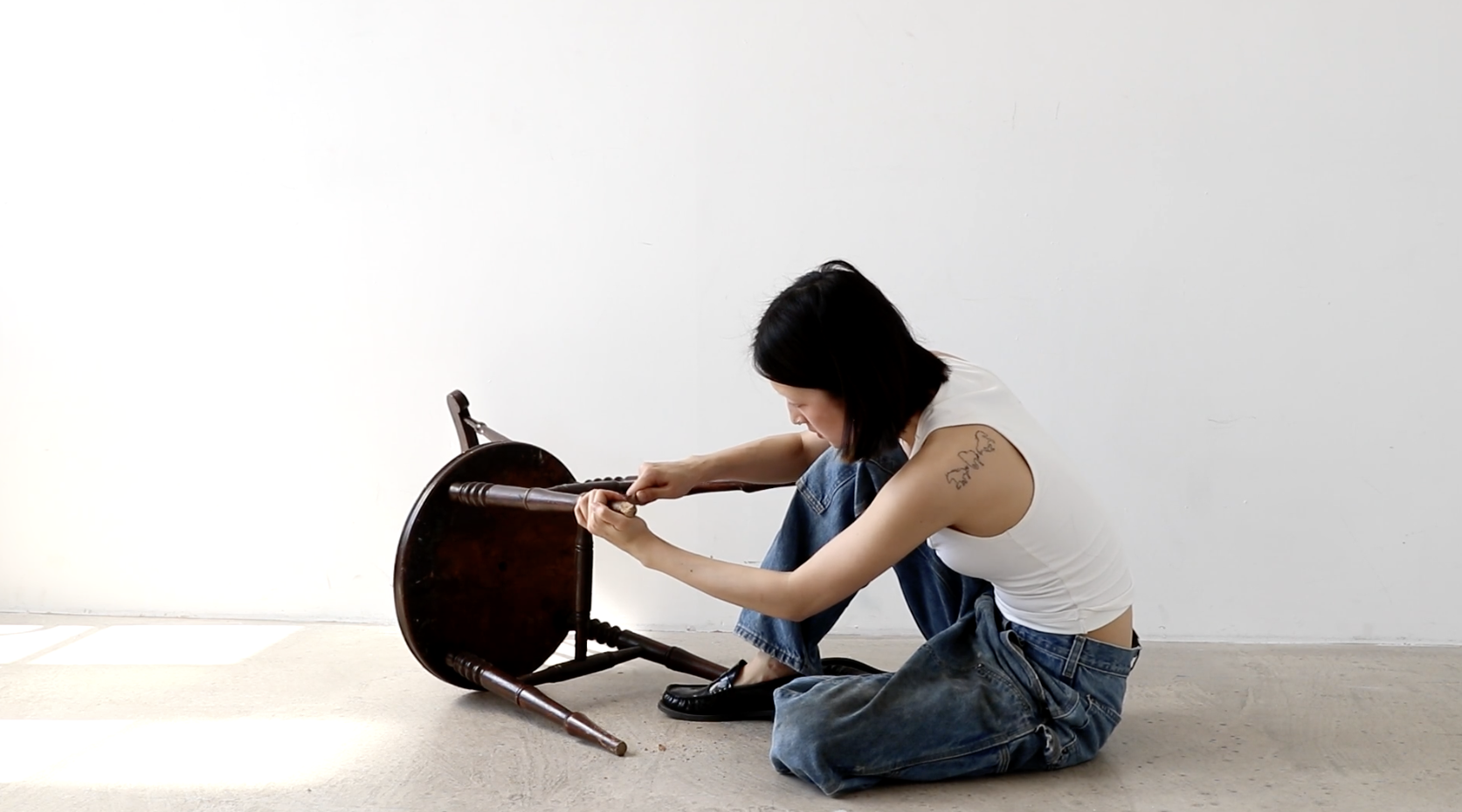
A dining knife repeatedly cuts into one leg of a chair. In fact, the damage the knife can inflict is vastly disproportionate to the hardness of the chair leg. With each cut, only the faintest scratch is left behind, appearing almost unchanged from before—until these nearly imperceptible marks accumulate into a wound two centimetres deep. Through this action, Millie draws a metaphor for the subtle and continuous erosion that modern life (or modernity itself) imposes on the individual.
After the performance, the work remains as a sculpture. The chair, marked by a two-centimetre wound, can still be used, but the instability it carries will forever coexist with its existence.
Millie’s reliance on lived sensation shapes her precision in expression. It is perhaps no coincidence that many artists move between art and hospitality work. What may seem like a necessity becomes, in practice, something more generative. As she describes it, working in hospitality adds texture to life and feeds directly back into her thinking and making. Handling materials, delivering outcomes, receiving immediate responses—these are efficient ways of feeling one’s own existence.
Between abstraction and lived pressure, everyone, perhaps, needs some sense of the real.
陈思旭(Millie-Sixu Chen),2000年出生于中国徐州。2021年于南京师范大学广告学系完成本科学业后,前往伦敦国王学院攻读传播学硕士,并于同期开始创作。其作品形式多为雕塑/装置,及表演,过往创作所讨论的议题主要围绕从个人经历与记忆出发的身份、归属及政治性暴力展开。现居伦敦。
I. 你要驯化我吗?
当她的简历与一众同辈艺术家放在一起时,陈思旭的教育背景令人耳目一新。从未接受过系统的艺术院校训练,是否意味着她步入艺术世界的路径注定有所不同?
陈思旭的艺术实践始于研究生阶段的一节选修课。课上对于去殖民, 身份, 离散的讨论,唤起了她搬来伦敦之后的某些记忆,牵引着她反复思考已发生的一切,并逐渐拼凑成她的第一件作品“Primary Education”,一场以拼贴艺术为载体的演讲。
陈思旭来到伦敦之后开始接触西方的约会文化。她能够感受到那些在西方背景之下成长的约会对象觉得“她和其他亚洲女孩不一样”,她说她享受这些瞬间。这样的说法不免令人皱眉。在她说出这句话的那一刻,她看起来像一个被父权制所制造的虚幻竞赛所套牢的蠢货——她在用这些瞬间证明自己高其他女人一等吗?还好她接着说,“我享受意识到面前的男人有多狭隘和愚蠢的瞬间”。于是她又变成了那种肩负社会责任,为某些权力某些平等摇旗呐喊的艺术家。然而,当人们试图向她确认这一身份时,她却又否认这种自觉。她说自己没想过用作品追逐这些议题,只是它们确实发生在自己的生活里。陈思旭不过是在回应,或者更准确地说,袒露它们所塑造的那部分自我。
体会到肆意表达的快感后,陈思旭一发不可收拾地开始创作。一个念头在她心里逐渐清晰:此生我无法摈弃“艺术家”的身份而存在。此后,她的创作形式逐渐开始转向雕塑、装置与表演。此类创作形式一方面带来了更多“创造”的乐趣,也因能够遭的空间和环境发生更多关系而具备更强的表现力;另一方面,却实打实地带来了一个十分实际的问题——相比起绘画,陈思旭的作品“不好卖”,这对于想要进入画廊体系的艺术家而言会是重大的阻碍。
形式的选择是“明知山有虎”的倔强吗?不是的。起初的陈思旭对此毫无概念。从没有读过艺术学校,没有听过太多艺术界传说与潜规则,她对“惯常的艺术家成长路径”一无所知。直到她凭借靠着直觉、灵气、天赋,和一点好运参加了几场展览,结识了一些从业者,看到了其他艺术家如何生活,她才迟钝地这些结构的存在。在尚不知方向的阶段,她很自然地试图复制那些惯常的路径。
她回到装裱作品,创作了取材于1980年代色情杂志的拼贴作品“Untitled Pleasure”。
从视觉层面来看,“Untitled Pleasure”无疑是一件完成度极高的作品。陈思旭以极强的掌控力平衡了色彩与构成,同时调动了色情杂志基因中的反叛气质以及对于人类原始冲动的挑逗,带来有力却不沉重,深刻又灵动的感官体验。策略性的考量与创作的成功并行——拼贴形式是物美价廉的畅销款,搭配走俏的“凝视”与“身体政治”主题——“Untitled Pleasure”是陈思旭向画廊体系献上的谄媚姿态。
这一策略确实为陈思旭打开了局面。“Untitled Pleasure”为她收获了不少展览邀约和业内的正面评价,但这种路径并未被持续执行。在此之后,陈思旭重新开始专注在雕塑/装置和表演上。她当然像爱自己的其他作品一样爱着“Untitled Pleasure”,可这件作品的创作动机对陈思旭而言并不是可持续的,长期的策略性导向创作对她而言索然无味。
当被置于一个极端设问之中:
如果必须在“部分创作迎合市场,获得画廊支持与难以想象的名利”与“进入国际性重要展览,生活小康,创作自由”之间选择,她会更倾向于过哪种生活?陈思旭坦言可能后者于她更具吸引力。
再被追问:如果真的处于后者的位置,她会参加更多政治性活动,讨论自己在作品中讨论的议题吗?毕竟话语所象征的权力是如此迷人。还是仍然要专注创作?
她说,还是创作吧,我觉得我还是会继续创作。
我们不知道她能走到哪一步,不知道在真的面对巨大的成功时她会做出怎样的选择,上述回应只是她当下的动作和感受,在此刻释放出强大的生命力。她带着近乎天真的勇气探索,对一切好奇,于是她尝试一切,一次次或有意识或无意识地走到那些完善的权力机器面前,似乎已经确定自己想要融入其中,又在大门向她打开的那一刻转身离开。其他人能听到在门外的她轻声问:你要驯化我吗?而无从得知她究竟是否正在挑衅。
II. 父权制所代表的一类叙事
陈思旭在“Untitled Pleasure”中所展露的对于“男性凝视”的处理,暗示着她对于相关素材的积累并非成于朝夕之间。事实也确实如此。早在硕士研究生阶段,陈思旭就已经对相关课题产生兴趣,并进行过系统研究。2023年,她将目光瞄准法属殖民时期的阿尔及利亚女性图像,剖析在当时外力暴力介入一个完整文化环境的情境下,双重权力压迫对被压迫者的塑造如何在图像中体现。该研究最终产出为策展项目“Not Written until Now: women in Algerian Independent War”,以及手册“ALGERIAN WOMEN IN FRAMES”。
文行至此出现的三件作品,件件不脱离两性间的权力关系纠缠。然而,这并非陈思旭创作的唯一主题,甚至并非核心主题。在“I Tried But There’s No Door”系列中,陈思旭以精准如手术刀的表达刻画了优绩主义乃至新自由主义创造的现代生活危机。
“钥匙”在作为象征时,常常与“解决办法”相关联。当某种解决路径被视为坚定的、唯一的信念,它便在同时转化成了能够紧紧捆绑人的锁链。“I Tried But There’s No Door II”就由若干把这样的链条组成。它们彼此交织,于半空中悬挂,交织成网状的陷进。“I Tried But There’s No Door I”带来一扇装有五个把手的门,大声宣告通向门后的途径从不单一。这些把手形态一致,如同彼此的回声;门依旧只有一扇。当人发现把手失效,甚至拆除整扇门之后,所面对的仍然是一堵墙。
现代生活的危机来自结构性的微妙控制。成功被定义,路径被收窄,却又以“多样性”的面貌被重新包装,从而削弱其暴力性。“多样性”作为新自由主义的惯用语时,不再等同于全然“相异性”,后者拒绝任何形式的经济利用,而前者被理解为一种资源,它可以且希望被充分榨取、只允许体制框架内的差异存在。表面的包容性往往起到去政治化的作用,这一点点“框架内的差异”所释放的空间,让身处体制之内的人误以为自己是自由的,让人行使自己的“自由意志”,为自己理想中的成功呕心沥血,心甘情愿接受披着“自我实现”外衣的压榨。陈思旭在讨论虚伪的多样性所带来的窒息感时,能够做到举重若轻地将个体在社会机器之中的无力感和盘托出。作品冷静、空灵的气质是从陈思旭的性格中流淌出来的,因为她创作的起点从不是有关某个情境的讨论,只是对于自我感受的复述,而她的感受正是无数个其他个体正在经历的挣扎。
从这一出发点,可以看到她作品之间隐约的内在线索。陈思旭一直以来所关注的,其实是一类她无法摆脱的、持续运作的叙事机制:
这类叙事通过分层与规范,将个体安置在不同位置。人在有限的信息与资源中理解自身处境,也在无形中接受结构所设定的边界。权力并非单向压制,而是在差异化的分配中被不断再生产:个体显然在更大的体系中受到限制,同时也在某些层级中获得局部的优势与认同。
每一级都在消化自己受到的压力,并向下一级释放。这种“局部获益”使人倾向于维护既有秩序,并在无意识中将规范向下延续。
这类叙事通常规定着单一化的成功标准与被规范化的上升路径。它一方面将复杂的生命经验压缩为可衡量、可比较的指标,另一方面狡猾地让“顺从”与“反抗”共用同一套评价体系,进一步巩固自身的牢固度。
当然,它也展示出某种弹性。有限的流动性与差异,使人感到通道仍然开放。于是,对根本逻辑的追问转化为对个体努力的检讨,也使权力的约束转化为一种被内化的选择,从而减弱其作为限制的可感知性。这一切都通过惯习与象征资本运作,够嵌入个体的欲望、判断与行动之中,使人们在追求自我实现的过程中,反复回到结构既定的轨道上。
尽管以上的文字描述了一套理论化的精密阴谋,但在事实上,这类叙事更像一个个不断自我修补的混乱生态系统。包括资本、性别、国家政治和文化在内的不同权力在这些叙事中交织,没有任何中心在设计或操控—。这是个体在此类叙事中感到无力的本源——当个体试图反抗,就会发现自己对面的是一整套超出个体尺度的体系,它高于人类有限生命的活动,不可能留下任何能够形成对抗的抓手。
对此,陈思旭似乎并不执着于对抗。她只管孜孜不倦,喋喋不休地讲述她所经历的一切。
III. 对世界的实感
现在的陈思旭在伦敦场的一家咖啡店打工,同时经营着自己的线上古着店。这些构成了她创作之外的生活,她说自己很享受这样的状态。
本科阶段,陈思旭曾在上海几家大广告公司实习和工作。彼时广告业还不像现在这样萧条。她跟进的项目拿着甲方大笔的预算,产出声势浩荡。但当时的陈思旭对这份工作的意义没有太大的感受,甚至夸张地说,她认为自己做的事让自己感到虚无。
这样的感受在陈思旭开始做艺术家、开始打工之后大大缓解。相比起过去由庞大且成功的数据构成的反馈,她更在意来自具体他人的回应。她说自己享受和观众交流,就算是有时候听听朋友怎么说也会让自己感觉很好。在咖啡店打工的日子里最高兴的时候就是和自己的常客聊上两句。陈思旭看重自己亲身与世界建立联系的过程,她需要对这个世界的实感。
她同样擅长描述她的感受。陈思旭所创作的第一件装置作品,“I Look Back And I See You”,就已足够印证这一点。儿时的相片被木条遮挡,仅留下个别窗口使照片可见,剩下的部分则若即若离,影影绰绰。如人们调动回忆时眼前所见总是模糊,只有某一两刻的画面分外清晰。从杂志上剪下的文字被去掉了上下文,无中生有地提示着那一刻的感受。金属丝穿过这段记忆,纠结,缠绕,然后向外生长,四面八方地深深刺入此后的人生。装裱这一切的相框沉甸甸的,样式极为精致优雅,却不属于当下的时代——不论你怎样虔诚且呕心沥血地珍惜那段时光,它也只会无法阻遏地渐渐远离此刻你所站立的地方。
由金属丝连结木条是陈思旭为与她来自相似背景的观众设置的情感触发器。等细等长的木条、竹条,用棉线或是麻绳缠绕连结,所制成的窗帘、餐垫、凉席等家居生活用品是属于特定年代的东亚记忆。陈思旭的童年时期,是这些物件广泛流行的尾声。伴随2001年中国加入世界贸易组织,改革开放进入新阶段,中国民众的物质生活水平以难以预料的速度提高,这些耐用实惠的老物件被甩在时代身后。陈思旭在这样的背景下成长,周遭变化之快,仅是日常生活中的信息就足矣令人自顾不暇,那些令她感到熟悉的物件消失得彻底又猝不及防。这样的事实是否在不知不觉中为这代人的生命植入了不安的底色:我难道真的什么都不能留住?这段时期所带来的记忆最终沉淀为繁多复杂的感受四散在这代人的内心深处,在看到这样熟悉又错位的元素时重新浮现。人在恍惚时总是最脆弱。陈思旭制造这样的脆弱时刻,然后抓住它们,在这几个瞬间里完成和观众私密的对话。
对于热爱通过亲身体验与世界建立联系的艺术家而言,开始创作行为艺术作品再不过情理之中。陈思旭的第一件行为艺术作品“A 2cm Wound”,创作于“I Look Back And I See You”不久之后,延续了相似的逻辑。一把餐刀不间断地切割椅子的其中一条腿,其实餐刀所能造成的伤害与椅子腿的硬度悬殊,每次落刀,椅子上只留下极浅的划痕,看起来和之前似乎并无二致,直到这样微不可查的伤害反复叠加成两厘米的伤痕。陈思旭以这一行为比喻现代生活(或现代性问题)对个体微妙而持续的侵蚀。表演结束之后的作品作为一件雕塑静静伫立。这把被带着两厘米伤痕的椅子仍然能正常使用,只不过使用时的晃动将永远与其本身的存在共存。
陈思旭依赖切身感受这个世界所带来的反馈,这一份执着也塑造着她描述感受时精准的表现力。艺术家或艺术从业者进入款待业工作的情况从来不在少数,乍一听确实像是为生计的无奈之举。但有趣的是,许多在这两个世界之间穿梭的朋友们都深深地热爱和享受着在款待业工作的时刻。如陈思旭说,在款待业工作的体验为生活增加了乐趣,也切实地反哺着自己的思考和创作。她亲手触摸生产的工具和材料,把成果送到顾客手中,即时得到反馈。很难否认,这是一种极高效的感受存在的方式。在形而上和现实压力之间,所有人都需要一点对于世界的实感。