side hustle review: "Before the Landscape" Chen Pai'an
Lance Chan
2026
Chen Paian, born in 1988 in Guangzhou, China, currently lives and works in Guangzhou. He graduated from the Sculpture Department of the Guangzhou Academy of Fine Arts and has continued his artistic practice ever since. His work breaks away from conventional paradigms by inventively embedding the visual grammar and methodologies of commercial advertising into the context of contemporary art. Through the deconstruction and reconstruction of commodity symbols, he develops a system that offers a profound insight into the cultural phenomena of consumer society.
Rooted in an interdisciplinary and cross-media practice, his works employ a humorous yet intelligent visual language that reveals a latent sense of the sublime beneath the apparent tensions between natural landscapes and artificial constructions.
In recent years, Chen Paian’s subjects have ranged widely while maintaining a remarkably unified personal style. Whether depicting mountains and rivers, natural scenery, urban environments, or even more intimate personal spaces such as his own room, all are absorbed into his distinct visual system.
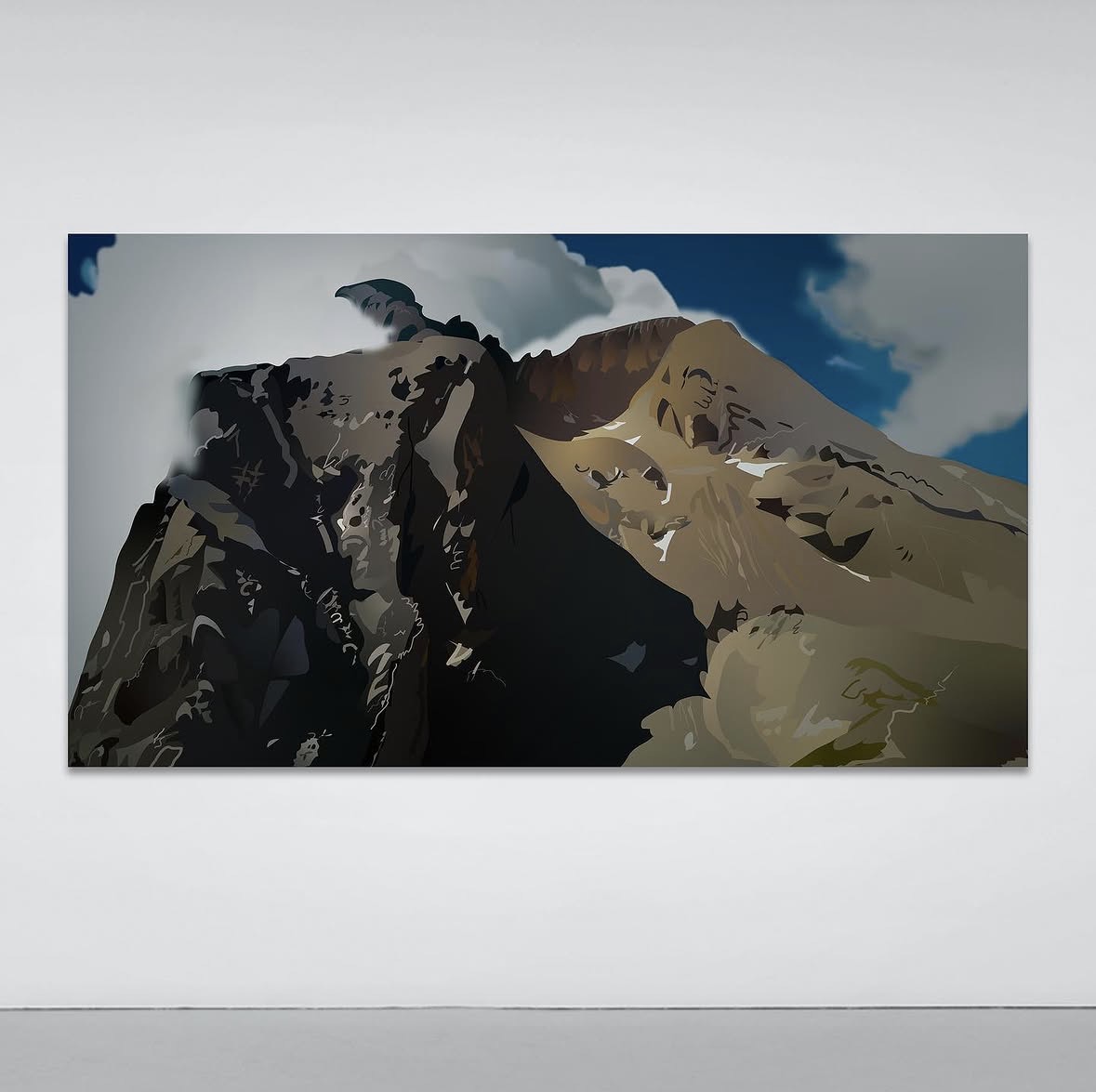
Through the flattening of natural landscapes into two-dimensional imagery, viewers gradually abandon their belief in the “sublime” of nature and are instead confronted with groups of privatized, possessable blocks of color. In works such as 18010007281402 and 22041420070, nature is no longer presented as dense forests, towering rocks, or flowing lakes, but as flattened images stripped of depth and context. Our awe of nature ultimately collapses into the melancholy of all that lies before our eyes.
This logic continues in his treatment of urban landscapes. Notably, compared to the organic lines often found in natural scenery, urban structures possess a distinctly geometric character. In response, Paian developed a corresponding painterly language capable of addressing the complex geometries of architecture. In 13513510051305, objects such as railings and air-conditioning units on building facades are abstracted and almost playfully simplified into rough, careless-looking lines. Though seemingly casual, these lines precisely capture the essence of the objects themselves. Meanwhile, the subtle and exact relationships between geometric color fields and shapes evoke the structure and texture of entire cityscapes with uncanny accuracy.
This is not merely a demonstration of technical skill, but also reflects a distinctly “nonchalant” painting philosophy — a visual language suspended between representation and abstraction. Paian employs line and color with remarkable precision, constructing a delicate balance between restraint and looseness. The result is a painterly condition that appears effortless while remaining highly controlled beneath the surface.
Before the Landscape
When we return to Paian’s early works in search of the “meaning” he repeatedly references in interviews, we may also begin to understand how his notions of “de-meaning” and “emptiness” emerged in the first place. Earlier in this text, I described his artistic language as humorous and witty. Yet within his more recent works, traces of this quality are increasingly difficult to identify directly. Only after revisiting his earlier works did I begin to realize that this humor had never truly disappeared; rather, it had gradually internalized itself into a more emotional form of humor. It no longer functions as self-deprecation, entertainment, or direct engagement with the viewer, but instead becomes a subtler and more repressed mode of perception.
For this reason, Paian’s early works were never as nihilistic or “meaningless” as he himself often suggests. On the contrary, many of these works are fundamentally concerned with how meaning itself is formed. He persistently investigates how language, color, form, and symbols become unconsciously established as seemingly natural structures of understanding through prolonged processes of socialization. As such, these works always contain a central proposition, though one that does not aim toward a definitive answer. Instead, they operate more like metaphysical inquiries. Rather than instructing viewers on how to understand the world, the works continuously destabilize the frameworks through which understanding itself takes place.
Take Orange and Pear (2019), for example. The two objects depicted are almost entirely identical, yet through a simple shift in color, Paian transforms them into two fundamentally different entities. The distinction appears so natural that we rarely question its legitimacy. But it is precisely within this sense of obviousness that a direct question emerges for me: if I had never undergone any form of socialization, would I still understand the difference between them? Or would I merely perceive two circular forms with a line inserted between them and a green shape attached above — incapable of recognizing them as an “orange” and a “pear”?
On this level, Paian’s early works already demonstrate his ongoing engagement with form, symbols, and preconditioned concepts. The viewer’s interpretation and gaze, in turn, become part of the conditions that allow the work to exist, rather than simply the result of viewing it. Meaning is not fixed within the image itself, but constantly reconfirmed, misread, and regenerated throughout the act of looking. Other early works such as Things Were Interesting at the Beginning and Swing carry similar tendencies. Often derived from minute observations of everyday life, these works contain traces of black humor alongside a subtle sense of displacement. At times these dislocations are so slight they are nearly imperceptible, yet it is precisely through this dissonance that familiar things begin to fracture. These works do not attempt to explain anything, nor do they seek to establish clear metaphors. Instead, through these minor dislocations, they quietly force us to reconsider how we come to understand the world itself.
From the almost instinctive and spontaneous state of his early creations, through periods of emotional fluctuation and creative stagnation, to the gradual formation of a more structured methodology and visual language in recent years, Paian’s artistic transformation appears less like a linear progression and more like a process of recalibrating his own creative condition. This transformation cannot simply be understood as “progress.” Rather, it feels more like a prolonged reassessment of his language, methodology, and position as an artist.
For artists, such changes are often easily interpreted as signs of maturity — techniques become more refined, accurate, and unified; works become easier to recognize, summarize, and categorize. To a certain extent, this is undoubtedly a condition welcomed by the market. A stable and identifiable visual system often signals stronger recognizability and a more developed artistic methodology.
Yet for the artist himself, this process is not necessarily an easy one. As artistic practice becomes increasingly structured, elements that were once chaotic, accidental, uncontrolled, or even immature are simultaneously organized, restrained, and sometimes erased altogether. And this disappearance is not merely technical; it often resembles a form of emotional exhaustion. For this reason, I do not see this transformation simply as a compromise with the market. Rather, it feels more like a conscious incorporation of the market, personal methodology, and artistic control into the work itself.
To some extent, this is indeed a form of maturity. But this maturity is also accompanied by an unmistakable emotional residue — a melancholy that emerges once emotion and humor become constrained by the stabilizing structures of the market. I am not entirely certain whether this feeling is intentionally expressed by the artist, yet throughout his recent works, I consistently sense its presence. Although he repeatedly insists that these works are “meaningless,” this very process of “de-meaning” appears to me less like emptiness and more like a direct emotional projection — as I described earlier, an inexpressible melancholy that lingers within everything we see.
中文:
陈拍岸,1988年生于中国广州,现居广州。本科毕业于广州美术学院雕塑系,后持续从事艺术实践至今。他的艺术实践突破传统范式,将商业广告的视觉语法与方法论创新性地植入当代艺术语境,构建出一套对商品符号进行解构与重构的体系,从而形成对消费社会文化现象的深刻洞察。
其创作以跨媒介实践为根基,通过幽默而机智的语言策略,在对自然景观与人工造景的双重凝视中,揭示出表面冲突之下潜藏的崇高本质。
在近年的创作中,陈拍岸的题材涉猎广泛,却始终保持着强烈而统一的个人风格。无论是高山流水、自然景观,还是都市空间,乃至更为私密的个体经验——如自身的房间——都被纳入其视觉体系之中。
在对自然景观的二维化处理之中,观者逐渐舍弃了对自然“崇高”的信念,转而面对一组组可被私有化、可被占有的色块。例如作品《18010007281402》与《22041420070》中,自然景观不再是茂密的森林、不再是耸立的岩石,也不再是流动的湖水,而成为失去深度与语境的平面图像。我们对自然的赞叹,最终坍缩为目之所及的惆怅。
而在对都市景观的处理中,这一创作逻辑亦被延续。值得注意的是,相较于自然景观中较为有机的线条,都市人造物在结构上具有截然不同的几何属性。对此,拍岸亦发展出一套相对应的绘画语言,以处理都市建筑中复杂而几何化的结构关系。例如在《13513510051305》中,大厦外部的栏杆、空调外机等物体,被抽象地、甚至近乎儿戏般地简化为一根根潦草的线条。它们看似随意,却又精准地概括并捕捉了物体本身的形态。而几何色块之间微妙而精确的色彩关系与形状安排,则近乎神似地勾勒出建筑群的结构与质感。
这不仅仅是技巧层面的体现,更承载着艺术家某种近乎 “nonchalant” 的绘画哲学——一种介于写实与抽象之间的视觉语言。拍岸精准地运用线条与颜色,在克制与松弛之间建立起微妙的平衡,形成一种看似毫不费力、实则高度控制的绘画状态。
景觀之前
當我們重新回到拍岸的早期作品,試圖尋找他在訪問中反覆提及的「意義」時,或許也能重新理解他所謂的「去意義化」與「空虛」究竟是如何誕生的。我在上文曾提到,拍岸的創作語言是幽默且機智的,但事實上,在近年的作品之中,已經很難直接找到支撐這種論調的明顯線索。直到重新回看其早期創作時,我才逐漸意識到,那種幽默其實從未真正消失,而是被慢慢內化成了一種情緒性的幽默——它不再是對觀眾的討好、自嘲或玩笑,而是一種更隱晦、更壓抑的感知方式。
也正因如此,拍岸早期的作品其實並沒有像他本人所說的「沒有意義」那般虛無。相反,很多時候,他真正處理的,反而是對「意義如何形成」的探討。他持續關注語言、色彩、形狀與符號,如何在我們長期的社會化過程中,被默默建立成某種理所當然的認知結構。因此,這些作品始終帶有某種核心命題,只是這種命題並不直接指向某個清晰的答案,而更接近於一種對形上問題的追問。它們並不試圖告訴觀眾應該如何理解世界,而更像是在不斷鬆動我們既有的理解方式。
例如《橘與梨》(2019),畫面中的兩個物體幾乎完全相同,但拍岸僅僅透過顏色的轉換,便將它們區分成兩種本質上不同的存在。這種區分看起來極其自然,以至於我們幾乎不會懷疑它的合理性。但也正是在這種「理所當然」之中,我開始產生一個極其直接的疑問:如果我是一個從未接受過任何社會化訓練的人,我依舊會理解它們之間的區別嗎?又或者,我所看見的,其實只會是兩個圓形,中間插著一根線,上方連接著一塊綠色的形體,而無法將其辨認為「橘子」與「梨」。
在這個層面上,拍岸早期的作品其實已經展現出他對形體、符號與既定概念的持續思考,而觀眾的解讀與凝視,在某種程度上也成為作品得以成立的條件,而不只是觀看之後的結果。作品的意義並非被固定地存放於畫面之中,而是在觀看的過程裡,被不斷重新確認、誤讀與生成。他其他的早期作品,例如《事情開始時是有趣的》與《蕩鞦韆》,同樣帶有這種傾向。它們往往來自對日常生活中極細微片刻的觀察,帶有某種黑色幽默,也帶有輕微的偏移感。那些偏移有時甚至微弱到難以察覺,但正是這種不協調,讓熟悉的事物開始出現裂縫。而這些作品並不是為了說明什麼,也不是為了建立某種明確的隱喻,它們更像是透過那些微小的錯位,重新讓我們意識到:我們究竟是如何理解這個世界的。
從早期那種近乎隨心所欲的創作狀態,到後來的情感波動、創作瓶頸,再到近年逐漸形成的方法論與結構化語言,在我看來,拍岸的創作轉變某種程度上更像是一種對自身創作狀態的重新調整。這種轉變並不是線性的,也未必能被簡單理解成一種「進步」。相反,它更像是一種在長期創作之後,對自身語言、方法與位置的重新確認。對藝術家而言,這樣的變化往往很容易被賦予某種成熟的意義——手法變得更加精煉、準確、統一;作品也因此更容易被辨認、被概括、被分類。某種程度上,這無疑是市場樂於接受的狀態。一種清晰、穩定且可被識別的視覺系統,往往意味著更高的辨識度與更成熟的創作方法。
但對藝術家本人而言,這未必完全是一件輕鬆的事情。因為當創作開始逐漸結構化之後,某些原本混亂、偶然、失控甚至不成熟的部分,也會被一同整理、收束,甚至消失。而這種消失,有時候並不只是技術性的,而更像是一種情緒上的耗損。因此,我並不認為這能被簡單地理解成一種向市場的妥協。相反,它更像是一種有意識地將市場、自我方法論與創作控制共同納入作品之中的過程。
某種程度上,這確實是一種成熟。但這種成熟,同時也伴隨著一種難以忽略的情緒,情緒與幽默感被市場約束後——一種來自結構逐漸穩定之後的惆悵。我並不確定這種情緒是否被他刻意表達,但在近年的作品之中,我始終能隱約感受到它的存在。雖然他反覆強調這些作品是「沒有意義」的,但在我看來,這種「去意義化」本身,反而更像是一種情緒的直接投射,正如我所説的,無法言喻的、目之所及的惆悵。